Signed in as:
filler@godaddy.com
Signed in as:
filler@godaddy.com
Especially water bearing cracks are the reason for corrosion on the reinforcement and jeopardize the safety of a concrete building. TPH offers secure and long term solutions for the crack injection in reinforced concrete.
All products, systems and solutions, which will be presented in the following chapters, are approved for many years on the sites and are in possession of a General Appraisal Certificate.
Especially water bearing cracks are the reason for corrosion on the reinforcement and jeopardize the safety of a concrete building. TPH offers secure and long term solutions for the crack injection in reinforced concrete.
All products, systems and solutions, which will be presented in the following chapters, are approved for many years on the sites and are in possession of a General Appraisal Certificate.

Rubber-elastic, 3 C acrylate gel, multi purpose applicable

Adjustable, rapid-reacting 3 C acrylate gel

2-component injection resin based on polyurethane

2-component high flexible injection resin based on polyurethane

Low-viscous, 2-component injection resin based on polyurethane

2-component resin based on Polyurethane, which foams up in contact with water

2K Polyurethane resin, which foams up in contact with water. Slowly curing, from ridged to tough elastic

Low-viscous 2-component injection resin based on epoxy

Very low viscous EP resin

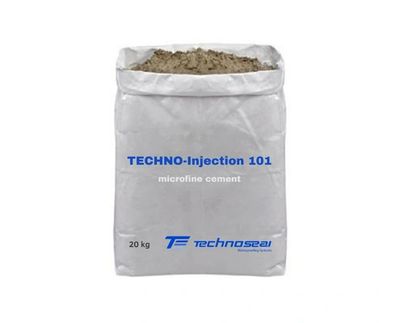
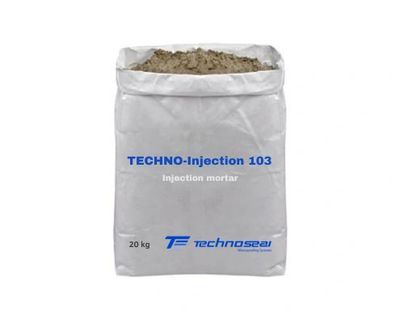
Single-component injection material based on extra-fine cement

Minerally, single component injection glue based on trass chalk according to DIN 1060

Ready to use dry mixture, non-shrinking.
RUBBERTITE in combination with POLINIT is employed for the injection into cracks in reinforced concrete buildings. POLINIT is a flexibilisation medium on a polyacrylic basis, which is used for the blending of the B component instead of water. POLINIT increases the flexibility as well as the adhesive power of the acrylate gels to silicate surfaces.
Even capillary cracks can be compressed reliably due to the extremely low blending viscosity of RUBBERTITE / POLINIT. A fissure that has been injected with RUBBERTITE/POLINIT is able to resist a water pressure of 4 bar at the simultaneous fissure expansion of 68% in comparison to the original width of the fissure. This was proven in the course of an application technological test.
PUR-O-CRACK, PUR-O-RIP and PUR-O-RIP LV are employed for the injection filling of cracks in reinforced concrete buildings. To achieve this purpose the fissures are initially diagonally spot drilled and high pressure packers are inserted into in the drill holes. A plugging of the crack, e.g. using the assembly cement F300 is usually necessary.
Prior to the injection procedure the single components are weighed or gauged in the prescribed mixing ratio and then blended in a special vessel or in the feed hopper of the injection pump. It is essential to ensure a homogeneous (free from reams) blending. After this the injection is carried out via the high pressure packers within the processing time for the respective product with the aid of single-component injection pumps. We recommended that the injection pump CONTRACTOR 1 U and ME 1K ELECTRICAL are employed for the processing of the Polyurethane resins PUR-O-CRACK, PUR-O-RIP and PUR-O-RIP LV.
VARIOTITE in combination with POLINIT is employed for the renovation of expansion joints. Initially the joint to be renovated is evacuated as profoundly as possible, i.e. the old joint sealant as well as the polystyrene joint filling is removed. Then the PROOFMATE E compression seal is pressed into the joint and the sealant applied with FIX-O-FLEX H. A PE back fill profile should be installed prior to the sealing process to prevent a three-flank adhesion of the joint sealant material.
When the FIX-O-FLEX H has completely hardened, the filled acrylate gel VARIOTITE / POLINIT is pressure injected into the remaining joint space. The acrylate gel can be inserted into the joint via injection packers or via a previously installed injection hose, for example, VPRESS® or ECOPRESS.
An expansion joint that has been renovated in this manner has been proven to resist a water pressure of 2 bar at a joint expansion of 48% in comparison with the original width of the joint.
Epoxy resins are composed of polymers. By addition of appropriate hardeners the mixture results in a synthetic material, which is being used in almost all part of craft work and industry. They have the distinction of a high resistance to chemicals, long life span, low weight, high adhesion ability and low shrinkage.
Epoxy resins are used for many years as injection material for the use of water proofing. Generally they are applied into reinforced concrete structures where solidification of the structure is required.
HYDROPOX EP1 is a two component, low viscous injection resin based on Epoxy with special chemical and physical properties. Due to its low viscosity EP1 can be used successfully in reinforced structures and even penetrate hair cracks. The special formulation allows processing of EP1 even on moist surfaces.
Before injecting HYDROPOX EP1 cracks have to be pinpointed in detail and backfilled, if necessary. Afterwards, cracks gets center drilled angular and the high pressure packers get placed. For processing of HYDROPOX EP1 the components have to be mixed according to the mixing ratio and get scrambled homogeneously. By means of a one component pump, e.g. CONTRACTOR 1 U or ME 1K ELECTRICAL cracks can be grouted.
Copyright © 2025 IC - All Rights Reserved.
We use cookies to analyze website traffic and optimize your website experience. By accepting our use of cookies, your data will be aggregated with all other user data.