Signed in as:
filler@godaddy.com
Signed in as:
filler@godaddy.com
Injection hoses are used as a planned joint insert for sealing construction joints, butt joints or block joints in structural engineering, civil engineering and tunnel construction.
Hose systems show their advantages not only in heavily reinforced components or in complicated geometries: In addition to conventional joint sealing systems, they can also serve as an additional “insurance policy” for leaks in the joint that occur years later, which can otherwise only be sealed with much greater effort.
In simple terms, in an injection hose system, a hose perforated with special slots is applied to the area of the subsequent joint using clamps before the concrete is poured; the ends of the hose are closed and stored so that they are still accessible after pouring.
After the shrinkage process of the concrete has been completed and the first settlements have occurred, a joint has formed around the injection hose, which enables the even distribution of the injection material. The special arrangement and shaping of the slots prevent cement slurry from penetrating the injection channel during casting.
During the so-called grouting, special crack filler is pressed into the tube. The injection pressure causes the filler to pass through the slits in the hose directly into the joint to be sealed. In the process, it also fills any faults and cavities in the concrete structure that may be due to compaction errors and finally reacts to form a permanently sealing mass: The joint is sealed.
TPH offers you high-quality sealing materials for the pressurised water-tight injection of injection hoses. All the materials presented below have proven themselves over many years and have proof of usability in the form of a general building inspection test certificate.
In addition to the VPRESS standard variant with an inner diameter of 6 mm, which can be grouted with microfine cement, acrylate gel and polyurethane resin and is mainly used in building construction, there is also a tunnel variant with an inner diameter of 10 mm, which can also be injected with grouting cement ZS-I / ZL-I.
Depending on the choice of grout, an injection hose can be grouted several times, so that another injection can be carried out in the event of moisture penetration occurring later.

Injection hose consisting of a slightly-foamed PVC with ribbed surface
Also with 10 mm inner-Ø for special requirements and overlength up to 30 m
Good locking into concrete

Injection hose consisting of a slightly-foamed PVC with ribbed surface

Rubber-elastic, 3 C acrylate gel, multi purpose applicable

Material for flexibility of acrylate gels

2-component injection resin based on polyurethane

2-component high flexible injection resin based on polyurethane

Low-viscous, 2-component injection resin based on polyurethane

2-component resin based on Polyurethane, which foams up in contact with water
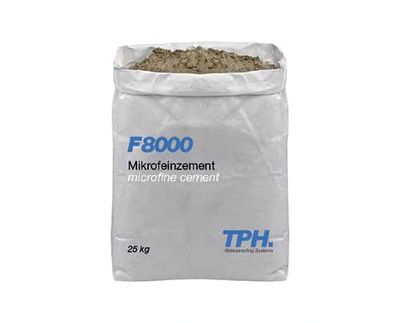
Single-component injection material based on extra-fine cement

Ready to use dry mixture based on cement, non-shrinking.

Injection and anchor mortar
For the grouting of the injection hoses VPRESS® and MEDIPRESS the acrylate gel RUBBERTITE / POLINIT has been approved by the building authorities to resist a water pressure of 5 bar. The benefit of the injection with RUBBERTITE / POLINIT as opposed to the compression with Polyurethane resins is that the acrylate gel can be injected several times.
On the one hand this depends on the consistency of the inner duct of the injection hoses VPRESS® and MEDIPRESS and on the other hand it depends on the fact that RUBBERTITE / POLINIT contains water as a solvent and consequently can be simply flushed from the hose without exerting pressure within the reaction time of the products. In this case the application of the injection pumps BOOSTER 10 A and MINIBOOSTER 5 U is recommended, which are equipped with an external scavenging pump.
A further benefit of the acrylate gel RUBBERTITE / POLINIT in the compression of injection hoses is the extremely low blending viscosity.
Whereas when Polyurethane resins are employed as the injection material the individual hose sections may not exceed a length of 10 m, when RUBBERTITE / POLINIT is employed also section lengths of up to 30 m, which could be necessary according to the particular construction, can be reliably compressed.
By reason of the extremely low viscosity the filling of the injection hose can be achieved in a few seconds on the one hand and, on the other hand, the even distribution of the acrylate gel in the construction joint can be accomplished without any difficulty even in the case of hose section lengths of 30 m. This has been proven in the course of an appropriate application technological test.
Copyright © 2025 IC - All Rights Reserved.
We use cookies to analyze website traffic and optimize your website experience. By accepting our use of cookies, your data will be aggregated with all other user data.