Signed in as:
filler@godaddy.com
Signed in as:
filler@godaddy.com
In the case of damp proofing work and renovation in the area of ingressing water, e.g. during tunnelling and in underground car parks, water frequently penetrates the construction through fissures and faults. In such cases Polyurethane foams and quick reacting Polyurethane resins, in particular have proven themselves to be very effective in the temporary arresting of water ingress.
Besides the foam formation and the short reaction time Polyurethane systems are especially suitable for the arresting of water ingress because they cannot mix with water.

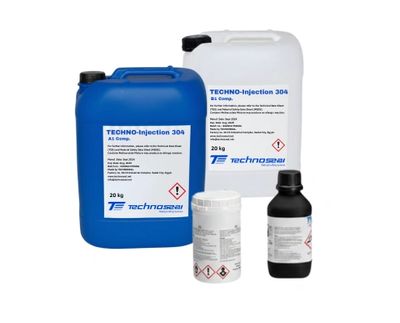
Adjustable, low viscous, quickly reacting 3-component acrylate gel

Adjustable, rapid-reacting 3 C acrylate gel

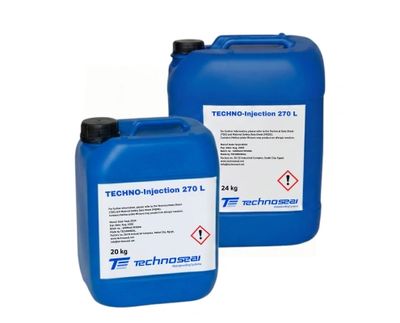
1-component injection resin based on polyurethane

1-component injection resin based on polyurethane

Very quickly reacting, from ridged to tough elastic, 2K polyurethane resin, which foams up in contact with water
From ridged to tough elastic, 2K polyurethane resin, which foams up in contact with water

Extremely fast reacting, from ridged to tough elastic, 2K polyurethane resin, which foams up in contact with water

Universal catalyst for shortening of reaction times of the PUR-O-STOP Systems like PUR-O-STOP HF, FS, FS-L, FS-F

Additive for increasing the viscosity of PUR-O-STOP FS, FS-L, FS-F.

Foaming, quick reacting, 2K Polyurethane based resin
It is possible to stop minor water ingress with the quick reacting acrylate gel VARIOTITE. To accomplish this, the product must be set to its most rapid reaction time (approx. 10-15 s), in that the relevant quantity of initiator is employed for the blending of the B component (see Technical data sheet).
The injection process should be carried out at a flow rate as high as possible via packers with a large inner diameter. Prior to this procedure the water ingress should be inhibited as far as possible. This can be accomplished using quick reacting cements such as F30 and F60 or by means of mechanical plugging, for example with cloths.
However, even quick reacting acrylate gels have their limitations in the stopping of ingressing water, because the acrylate gels are water soluble. On incidence of considerable faults through which the water can permeate the component, as well as in event of an extremely high flowing rate of the water, it would be more sensible to employ Polyurethane foams such as PUR-O-STOP to inhibit the water ingress, as these cannot be diluted by the water.
PUR-O-STOP and PUR-O-STOP HF are suitable for the temporary arresting of ingressing water. The fact that this is a temporary sealant has nothing whatsoever to do with the fact that PUR-O-STOP and PUR-O-STOP HF are not products for permanent application. Rather the injection against ingressing water has an impact on the recipe of the Polyurethane systems as these react with water.
If the water ratio is too high in comparison with the product quantity, foams could arise, which would not be durable on a permanent basis. Whereas if the water ratio matches the product quantity, permanently durable foams would be created. However, as the quantity of water on a building site cannot be verified, Polyurethane foams are customarily defined as temporary sealants.
A permanent sealing is accomplished by the retro-injection of two component Polyurethane resins, such as PUR-O-CRACK and PUR-O-RIP or of acrylate gels, such as RUBBERTITE and VARIOTITE.
Copyright © 2025 IC - All Rights Reserved.
We use cookies to analyze website traffic and optimize your website experience. By accepting our use of cookies, your data will be aggregated with all other user data.